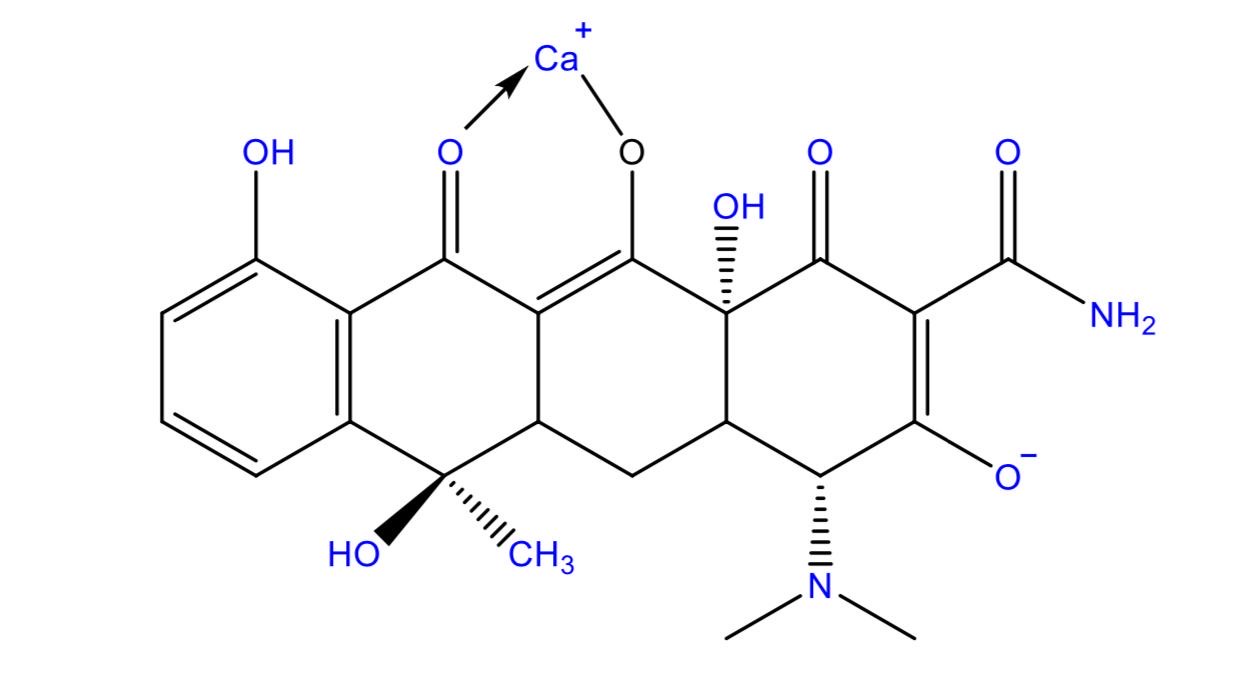
An organic coordination compound, or molecular complex, is composed of constituents held together by weak interactions such as donor–acceptor forces or hydrogen bonds. Molecular complexes can be classified according to:
- The bonding or interaction between substrate and ligand (e.g., electrostatic interaction, charge-transfer, hydrogen bonding and hydrophobic interaction).
- Type of substrate and ligand forming the complex (e.g., small molecule—small molecule, small molecule—macromolecule, enzyme—substrate, drug— receptor and antigen—antibody).
- Type of structure formed (e.g., self-assembled aggregate, micelle, clathrate, and inclusion complex).
There is a difference between complexation and the formation of organic compounds. The compounds dimethylaniline and 2,4,6-trinitroanisole react in the cold to give a molecular complex:

On the other hand, these two compounds react at an elevated temperature to yield a salt, where the constituent molecules are held together by primary valence bonds:
- The dotted line in the complex of equation indicates that the two molecules are held together by a weak secondary valence force. It is not to be considered as a clearly defined bond but rather as an overall attraction between the two aromatic molecules.
- The type of bonding present in molecular complexes where hydrogen bonding is absent is not fully understood. However, it can be considered to involve an electron donor–acceptor mechanism similar to that in metal complexes, though typically much weaker.

Quinhydrone Complex
When alcoholic solution of benzoquinone and alcoholic solution of hydroquinone are mixed in equel molar centration they from quinhydrone complex.

Picric acid Complex
Picric acid (2,4,6-trinitrophenol) is a strong acid that forms molecular complexes with many weak bases, such as polynuclear aromatic compounds. An example is Butesin picrate (local anaesthetic) which is a complex formed between two molecules of butyl p-aminobenzoate with one molecule of picric acid. Butesin has anaesthetic property and picric acid has antiseptic property. Butesin complexes with picric acid and form butesin- picrate ointment of the complex is used in treatment of burns.

Drug and Caffeine Complexes
The complexation of caffeine with various acidic drugs is primarily attributed to several types of interactions. Specifically, these include dipole-dipole forces and hydrogen bonding between the polarized carbonyl groups of caffeine and the hydrogen atom of the acid. Consequently, these interactions facilitate the formation of the complex. A secondary interaction likely occurs between the nonpolar parts of the molecules, causing the resultant complex to be “squeezed out” of the aqueous phase due to the high internal pressure of water. These combined effects result in a strong degree of interaction.

Caffeine forms molecular complexes with organic acid anions that are more soluble than pure xanthine. However, the complexes formed with specific organic acids, such as gentisic acid, are less soluble than caffeine alone. Therefore, the solubility of these complexes can vary significantly depending on the organic acid involved. Such insoluble complexes provide caffeine in a form that masks its normally bitter taste and should serve as a suitable state for chewable tablets. 1:1 and 1:2 caffeine–gentisic acid complexes were synthesized, and their equilibrium solubility and dissolution rates were measured. Both complexes were found to be less soluble in water than caffeine, and their dissolution rates were also lower than that of caffeine. Chewable tablets formulated from these complexes could offer an extended-release form of the drug with an improved taste.
Reference:
- Sinko, P. (2011). Martin’s Physical Pharmacy and Pharmaceutical Sciences. Baltimore, : Lippincott Williams & Wilkins, a Wolters Kluwer business.
- Felton. L. (2013). Remington Essentials of Pharmaceutics. London. UK: Pharmaceutical Press.