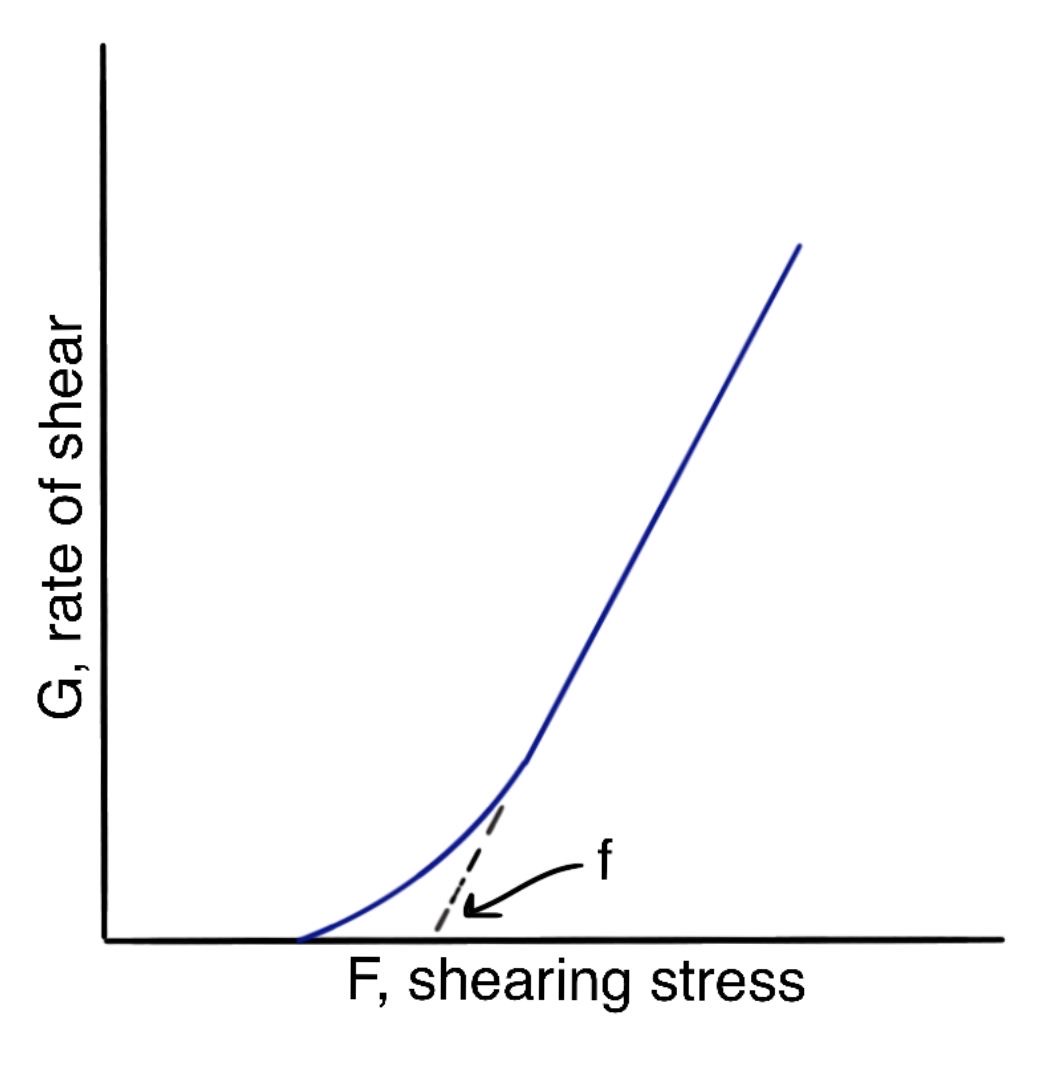
Bulges and spurs represent complex hysteresis loops observed in pharmaceutical dispersions when sheared in a viscometer. In this process, the shear rate, rather than the shear stress, is increased to a certain point and then decreased, with shear stress measured at each shear rate to create the appropriate rheograms. Figures 4 and 5 illustrate two such complex structures (bulges and spurs).
Bulges

A concentrated aqueous bentonite gel, at 10% to 15% by weight, generates a hysteresis loop with a characteristic bulge in the upcurve. This is attributed to the crystalline plates of bentonite forming a “house-of-cards” structure, which causes the swelling of bentonite magmas. This three-dimensional structure results in the bulged hysteresis loop seen in Figure 4. In even more highly structured systems, such as a procaine penicillin gel. for intramuscular injection, the bulged curve may develop into a spurlike protrusion, as shown in Figure 5.
Spurs

This structure demonstrates a high yield or spur value, Y, which traces a bowed upcurve when the three-dimensional structure breaks in the viscometer. The spur value represents a sharp point of structural breakdown at low shear rates. Producing the spur is challenging, and it may not be observed unless the gel sample is allowed to age undisturbed in the cup-and-bob assembly. Therefore, this must be done for some time before the rheologic run. Subsequently, the spur value is obtained using an instrument where the shear rate can be slowly and uniformly increased, preferably automatically. Meanwhile, the shear stress is recorded on an X-Y recorder as a function of shear rate. Additionally, penicillin gels with distinct Y values were very thixotropic. Consequently, they formed intramuscular depots upon injection, which provided prolonged blood levels of the drug.
Reference:
- Sinko, P. (2011). Martin’s Physical Pharmacy and Pharmaceutical Sciences. Baltimore, : Lippincott Williams & Wilkins, a Wolters Kluwer business.